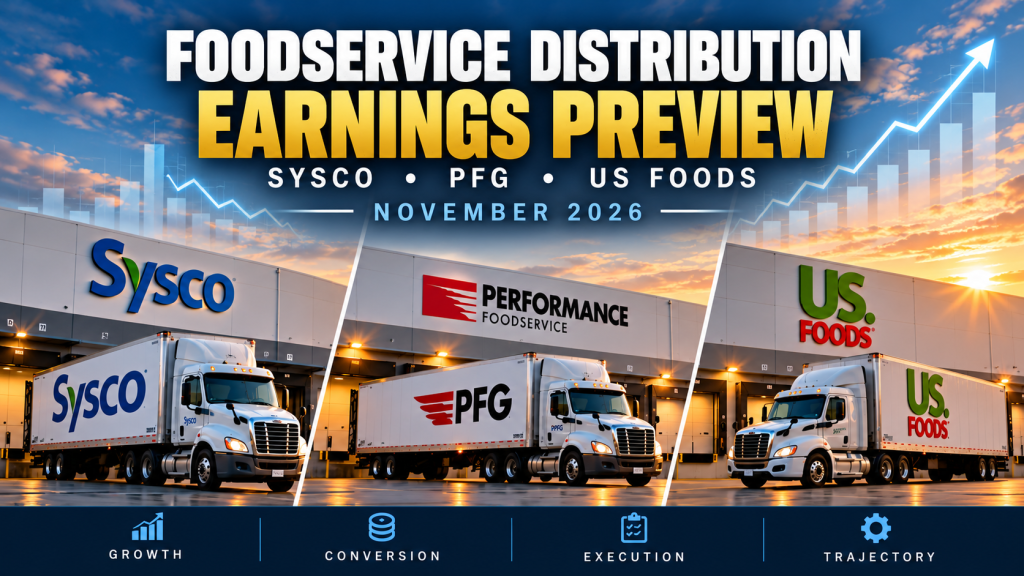
Three of the nation’s largest foodservice distributors are preparing to release their quarterly earnings reports in early November. The results could provide valuable insight into restaurant demand, foodservice inflation, and the overall direction of the distribution industry.
Sysco, Performance Food Group (PFG), and US Foods are scheduled to report earnings on November 3, 4, and 5, respectively.
While investors will be paying close attention to revenue, profitability, and earnings per share, there is another important part of these reports worth examining: what the numbers tell us about the health of the restaurant industry and the distributors that supply it.
Having worked in both restaurant management and foodservice distribution, I find these reports particularly interesting. They provide a broader look at many of the challenges operators and distributors experience every day.
Revenue Growth Doesn’t Always Tell the Whole Story
One of the first numbers investors typically examine is revenue growth. However, in foodservice distribution, increasing revenue doesn’t necessarily mean distributors are selling more food.
Revenue can increase for several reasons, including higher product prices, acquisitions, and increased case volume.
For example, a distributor could report higher sales because food costs increased, even if the actual number of cases delivered remained relatively unchanged.
That’s why case volume is an important metric to watch.
Case growth can help indicate whether distributors are gaining customers, expanding business with existing accounts, or experiencing stronger demand across their customer base.
Another particularly interesting measurement is independent restaurant case growth.
Independent restaurants represent an important segment of the foodservice industry, and their purchasing activity can provide insight into how distributors are performing with smaller, locally operated businesses.
However, it’s important to remember that stronger case growth at a distributor doesn’t automatically mean restaurants themselves are performing better. A distributor could be gaining market share from competitors even while overall restaurant demand remains relatively flat.
Profitability: Turning Sales Growth Into Earnings
Growing sales is one thing. Turning those additional sales into profit is another.
Foodservice distribution is a high-volume business with substantial operating expenses.
Distributors must manage warehouses, transportation fleets, labor, fuel, inventory, and product sourcing while maintaining competitive pricing for customers.
Even relatively small changes in operating expenses can have a meaningful impact on profitability.
Two financial measurements worth watching are operating income and adjusted EBITDA, which companies use to help explain their operating performance.
The question is whether distributors are improving profitability as sales increase.
For example, if a company reports strong revenue growth but operating income increases at a much slower pace, it could suggest that additional expenses are absorbing some of those gains.
On the other hand, improving profitability alongside case growth could indicate better purchasing efficiency, improved delivery productivity, or stronger expense management.
Each company’s results need to be evaluated individually because their customer mix, operating structure, and reporting methods differ.
What to Watch From Each Distributor
Sysco — November 3
Sysco remains the largest broadline foodservice distributor in the United States.
Its upcoming fiscal first-quarter earnings report should provide insight into U.S. Foodservice case volume, operating profitability, and management’s ongoing efforts to improve efficiency.
Areas worth watching include local customer case growth, transportation expenses, and the company’s progress on cost-saving initiatives.
It will also be interesting to hear management’s comments regarding customer demand and competitive conditions across the restaurant industry.
Performance Food Group — November 4
Performance Food Group operates across several food distribution segments, including its Performance Foodservice business.
Its upcoming fiscal first-quarter results should offer additional insight into independent restaurant case growth, profitability, and operating costs.
One area worth monitoring is the relationship between case volume growth and adjusted EBITDA.
Higher case volume can create opportunities for better operating efficiency, but the cost of servicing that additional business remains important.
Fuel expenses, labor productivity, and purchasing costs will also be worth following.
US Foods — November 5
US Foods is scheduled to report its third-quarter 2026 results on November 5.
Independent restaurant case growth will be one of the more interesting measurements to examine, particularly as the company continues focusing on customer growth and operational improvements.
Other areas worth watching include adjusted EBITDA, sales productivity, and the company’s ability to manage distribution expenses.
Like its competitors, US Foods must balance growth with the cost of servicing customers.
The company’s commentary on restaurant demand, customer purchasing patterns, and operating efficiency could provide additional perspective on conditions across the industry.
Technology and Artificial Intelligence in Food Distribution
Another subject worth following is how distributors are investing in technology and artificial intelligence.
Foodservice distribution involves enormous amounts of information, from product purchasing and inventory management to delivery routing, pricing, and customer ordering.
Technology has the potential to improve efficiency in several areas.
For example, better forecasting could help distributors manage inventory and reduce product waste. Improved routing systems could lower transportation costs, while digital ordering tools could make purchasing easier for restaurant operators.
However, the real question is whether these investments are producing measurable results.
Are distributors reducing operating expenses? Are sales representatives becoming more productive? Are restaurants experiencing fewer ordering errors or more reliable deliveries?
Investing in technology is one thing. Demonstrating its financial and operational benefits is another.
As these companies continue developing their technology platforms, it will be interesting to see how much detail they provide about the actual returns on those investments.
What These Reports Mean for Restaurant Operators
Although quarterly earnings reports are primarily written for investors, they can also provide useful information for restaurant owners and managers.
Foodservice distributors play a significant role in restaurant operating costs and supply chain reliability.
Changes in distributor pricing, product availability, transportation expenses, and purchasing strategies can eventually affect the restaurants they serve.
For restaurant operators, the most important measurements are often much simpler than the financial metrics discussed during earnings calls.
Are deliveries arriving on time? Are orders accurate? Is product quality consistent? Are prices competitive? Is the distributor helping the restaurant operate more efficiently?
A distributor can report impressive financial results, but restaurants ultimately judge that company through their daily experiences.
That relationship between financial performance and customer service is something worth keeping in mind when reviewing these reports.
Looking Ahead
With Sysco reporting November 3, Performance Food Group November 4, and US Foods November 5, the first week of November should provide a clearer picture of the current foodservice distribution environment.
I’ll be particularly interested in comparing independent restaurant case growth, profitability, and management commentary about customer demand.
The results may also offer clues about whether distributors are benefiting primarily from gaining market share or from stronger overall restaurant activity.
For an industry responsible for moving billions of dollars in food products to restaurants, schools, healthcare facilities, and other establishments, these earnings reports offer a valuable look at the business behind the plate.
And while the financial numbers will certainly attract attention, the bigger question remains: Are these distributors growing in a way that benefits both their businesses and the customers they serve?


Leave a Reply