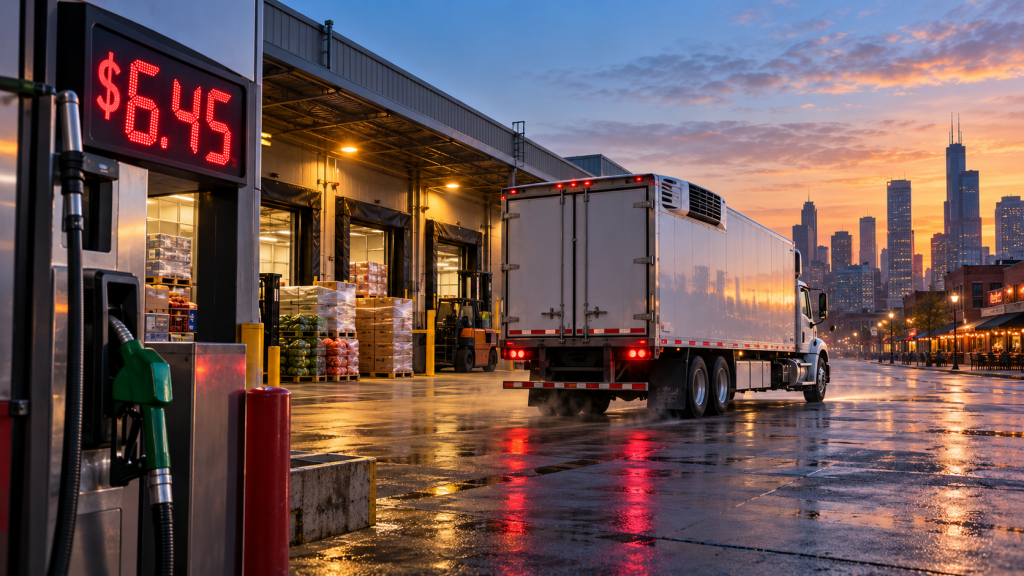
The national average price of diesel remains above $6 per gallon.
As of September 28, 2026, AAA reports a national average of approximately $6.45 per gallon. That is down slightly from last week’s record levels, but still nearly $2.77 more per gallon than it was one year ago.
For restaurant operators, this may sound like a trucking problem.
It isn’t.
Diesel touches nearly every step of the foodservice supply chain. It helps move products from farms and processing plants to distribution centers, powers refrigerated transportation and ultimately supports the final delivery to the restaurant’s back door.
When diesel becomes significantly more expensive, the added cost does not remain confined to the fuel tank. It works its way through the entire system.
Why Foodservice Distribution Is Particularly Exposed
Foodservice distribution is more complicated than moving a full truckload from Point A to Point B.
A typical delivery truck may leave the warehouse carrying dozens of individual customer orders. It can make numerous stops, travel through congested areas, operate refrigeration equipment and return to the distribution center before repeating the process the following day.
Each delivery requires more than fuel. It also requires drivers, warehouse labor, equipment, maintenance, insurance, technology and the infrastructure needed to receive, store, select and deliver thousands of different products.
Diesel is only one component of that cost, but a sharp increase places additional pressure on an already expensive delivery network.
What Happens When Diesel Rises?
When diesel prices rise dramatically, three things generally happen.
First, distributors look for ways to recover the additional expense. That may include fuel surcharges, delivery fees, pricing adjustments or a stronger focus on account profitability.
Second, restaurant operators push back. They are already managing food, labor, rent, utilities, insurance and numerous other operating expenses. Another increase—even one rooted in transportation—can be difficult to absorb.
Third, and perhaps most importantly, higher fuel costs expose weaknesses that were easier to overlook when diesel was cheaper.
Poor route density becomes more expensive.
Small deliveries become less profitable.
Long or restrictive delivery windows become more costly.
Underutilized trucks matter more.
Inefficient warehouse and delivery networks become harder to justify.
When fuel costs less, some of those inefficiencies can hide within the broader operation. At more than $6 per gallon, they become much easier to see.
The Importance of Route Density
Route density is one of the most important parts of foodservice distribution economics.
A distributor serving several restaurants located close together can spread its transportation and labor costs across multiple deliveries. A truck traveling farther to make a small number of widely separated stops has a much higher cost to serve each customer.
That does not necessarily mean a remote restaurant is a bad account. It means the distributor must consider the complete relationship, including order size, delivery frequency, product mix, gross profit and the time required to complete the delivery.
This is why minimum-order requirements, delivery schedules and cutoff times matter. They are not simply arbitrary rules. They help distributors create enough efficiency to operate a profitable delivery network.
Smaller Orders Become More Expensive
The truck still has to reach the restaurant whether it is delivering 10 cases or 50.
Many of the basic expenses associated with that stop remain the same. The driver must travel to the location, find a place to park, unload the order, verify the delivery and complete the necessary paperwork or electronic confirmation.
A small delivery spreads those expenses across fewer cases and fewer sales dollars.
As fuel and labor costs increase, distributors may place more attention on small drops, frequent deliveries and accounts that regularly require special accommodations.
For restaurant operators, this makes order planning increasingly important. Consolidating purchases, reducing emergency deliveries and placing more complete orders can help lower the cost and complexity of servicing the account.
Cost to Serve Matters More Than Ever
The most important question for a distributor should not simply be:
“How much is fuel costing us?”
The better question is:
“What is our true cost to serve each customer?”
That calculation extends far beyond diesel. It includes order size, gross profit, delivery frequency, distance, route time, warehouse touches, product substitutions, returns, credits and the amount of sales and customer-service support an account requires.
An account can generate a large amount of revenue and still be difficult to serve profitably. Another account may purchase less overall but fit efficiently into an existing route, order consistently and create very little operational complexity.
Understanding that difference becomes especially important when fuel costs are rising.
Could Higher Diesel Prices Accelerate Consolidation?
Larger distributors generally have more resources available to absorb or offset higher transportation expenses. They may have stronger purchasing leverage, greater route density, larger fleets, more sophisticated routing technology and broader distribution-center networks.
Smaller and regional distributors can still compete through service, flexibility, local knowledge and strong customer relationships. However, sustained increases in fuel, labor and equipment costs can place significant pressure on businesses already operating with thin margins.
That could create additional opportunities for consolidation.
A regional distributor with loyal customers but inefficient purchasing, routing, fleet utilization or warehouse operations may struggle independently. The same company could become significantly more valuable as part of a larger platform capable of improving purchasing power and combining delivery networks.
For private-equity firms and strategic buyers, higher operating costs may reveal both struggling businesses and potential acquisition opportunities.
The strongest distributors may emerge with opportunities to expand. Others may find it increasingly difficult to compete without additional scale.
What Restaurant Operators Should Watch
Restaurant operators may not have direct control over diesel prices, but they can pay attention to how distributors respond.
That includes watching for:
- New or increasing fuel surcharges
- Higher delivery minimums
- Changes to delivery days or windows
- Greater pressure to consolidate orders
- Pricing adjustments on freight-sensitive products
- Reduced service to isolated or low-volume accounts
- Additional consolidation among regional distributors
Operators should also consider how their own ordering practices affect the cost of service. More predictable orders, fewer emergency deliveries and better inventory planning can make an account easier and more economical to support.
The Bigger Picture
At $3 or $4 per gallon, operational inefficiencies can sometimes remain hidden.
At more than $6, they become highly visible.
The foodservice companies best positioned to navigate this environment will be the ones that understand their cost to serve at the customer, route, product and distribution-center levels.
For restaurant operators, the effects may appear through pricing, delivery policies and product costs. For distributors, the challenge will be balancing customer service with the economic reality of operating a complex delivery network.
Diesel may be the immediate issue, but the larger conversation is about efficiency.
The price at the pump is simply making that conversation impossible to ignore.
Source: AAA national fuel-price averages, September 28, 2026.


Leave a comment