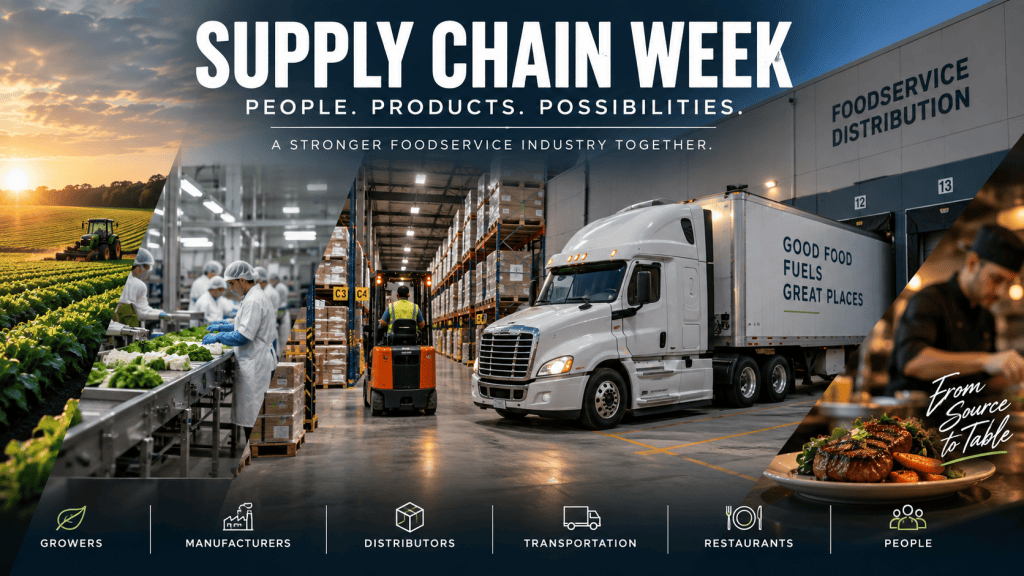
Most restaurant customers never think about the supply chain.
You walk into a restaurant, order a burger, plate of wings, salad, steak, or seafood, and a few minutes later the food hits the table.
Simple enough.
But anyone who has worked in restaurants or food distribution knows there is a much more massive operation behind that plate.
Before that case of chicken ever reaches a restaurant, somebody had to raise it, process it, package it, sell it, forecast demand for it, move it through a distribution center, load it onto a truck, and deliver it.
And all of that has to happen at the right temperature, at the right time, in the right quantity, and at a price that still allows the restaurant to make money.
That is what makes Supply Chain Week worth recognizing.
The Supply Chain Starts Long Before the Distributor
When we talk about foodservice supply chains, distributors like Sysco, US Foods, Performance Food Group, and Gordon Food Service naturally come to mind.
But the chain starts much earlier.
Think about something as simple as an order of french fries.
The potatoes have to be grown and harvested. They are transported to a processor, where they are cleaned, cut, processed, frozen, packaged, and eventually shipped.
From there, pallets may travel hundreds or even thousands of miles before arriving at a foodservice distribution center.
The distributor then has to forecast how much product customers will need, maintain inventory, receive orders, select cases, load trucks, and deliver those fries to restaurants.
Only then does somebody in the kitchen open the case and drop them into a fryer.
The customer sees fries.
The supply chain sees agriculture, manufacturing, transportation, warehousing, inventory management, sales, logistics, labor, and a whole lot of coordination.
Food Distribution Is the Middle of a Massive Network
Food distributors occupy an interesting position in this system because they connect thousands of products from hundreds of manufacturers with thousands of individual restaurants and foodservice operations.
A restaurant might order chicken from one producer, french fries from another, produce from another, seafood from another, cleaning chemicals from another, and disposable products from several more manufacturers.
Instead of arranging separate deliveries from every supplier, the distributor brings those products together.
One truck can arrive carrying everything from ribeyes and shrimp to fryer oil, lettuce, ketchup, gloves, takeout containers, and toilet paper.
That consolidation is one of the biggest values food distributors provide.
But making it happen is much more complicated than simply putting cases on a truck.
Forecasting Matters More Than Most People Realize
One of the most interesting parts of food distribution is inventory.
Having too little product creates out-of-stocks and disappointed customers.
Having too much can be just as dangerous.
Food has shelf life.
Produce deteriorates. Fresh meat ages. Frozen inventory takes up valuable freezer space. Products change. Restaurants change menus. Demand changes with seasons, holidays, weather, sporting events, tourism, commodity prices, and countless other factors.
Someone has to predict what customers are going to need before they actually order it.
Multiply that across thousands of products and hundreds or thousands of customers, and inventory management becomes a massive balancing act.
A restaurant operator may only see that their preferred product is unavailable.
Behind that out-of-stock could be anything from unexpected demand to a manufacturer shortage, transportation delay, production issue, crop problem, weather event, or forecasting miss.
Then There Is the Transportation
Food doesn’t just have to move.
It has to move correctly.
A foodservice truck may contain frozen, refrigerated, and dry products all on the same route.
Frozen seafood needs to remain frozen. Fresh chicken needs to remain refrigerated. Produce needs temperature control. Dry groceries need protection from moisture and damage.
And then the driver may have 15, 20, or more stops to make.
Restaurants also aren’t always designed with delivery efficiency in mind.
Drivers deal with downtown streets, tight parking lots, stairs, narrow kitchens, loading zones, locked storage areas, early-morning deliveries, and restaurants trying to prep for service while a delivery is arriving.
It is one of the most physically demanding and important jobs in the foodservice supply chain.
Without the driver, everything upstream means very little.
The Restaurant Is the Final Link
Eventually, all of that work reaches the restaurant.
The order gets checked in.
Cases get moved into coolers, freezers, and dry storage.
The kitchen turns those raw ingredients into something a customer is willing to pay for.
And that is ultimately the entire purpose of the foodservice supply chain.
Every farmer, processor, manufacturer, buyer, warehouse worker, selector, loader, driver, salesperson, chef, manager, and restaurant employee is connected by the same basic objective:
Get the right product to the right place at the right time.
When it works correctly, nobody notices.
When it doesn’t, everybody notices.
We Learned That Lesson During COVID
If there was ever a period when the average person became aware of supply chains, it was during the COVID-19 pandemic.
Products disappeared from shelves.
Manufacturers struggled with labor.
Restaurants changed purchasing patterns almost overnight.
Transportation networks were disrupted.
Packaging became difficult to source.
Certain products that businesses had taken for granted suddenly became unavailable.
The pandemic showed just how interconnected modern supply chains really are.
A problem at one processing facility, port, manufacturer, or transportation network can eventually affect a restaurant hundreds or thousands of miles away.
It also demonstrated how resilient the food industry can be.
Suppliers found alternatives. Distributors adjusted inventory. Restaurants changed menus. Drivers kept delivering. Manufacturers changed production.
The system bent, sometimes significantly, but it kept moving.
Supply Chains Are Still Changing
The foodservice supply chain continues to evolve.
Technology is improving forecasting and inventory management. Restaurants have better access to purchasing data. Distribution centers are becoming increasingly automated. Route planning continues to improve. Manufacturers are looking for ways to reduce waste and improve efficiency.
At the same time, operators continue dealing with food costs, labor costs, transportation expenses, commodity volatility, and changing customer expectations.
That makes supply chain efficiency increasingly important.
A few cents per pound on chicken or a couple dollars per case may not sound significant.
Multiply those differences across hundreds of cases, thousands of restaurants, and an entire year, and they become enormous numbers.
The Business Behind the Plate
Supply Chain Week is a good reminder that the food on our plates doesn’t simply appear.
There is an enormous network working behind it.
Somebody grew it.
Somebody processed it.
Somebody sold it.
Somebody forecasted it.
Somebody selected it.
Somebody loaded it.
Somebody drove it.
Somebody received it.
And finally, somebody cooked it.
Most of those people will never meet the person who eventually eats the food.
But every one of them played a role in getting that meal onto the table.
That is the business behind the plate.
And without the supply chain, there is no plate.


Leave a comment