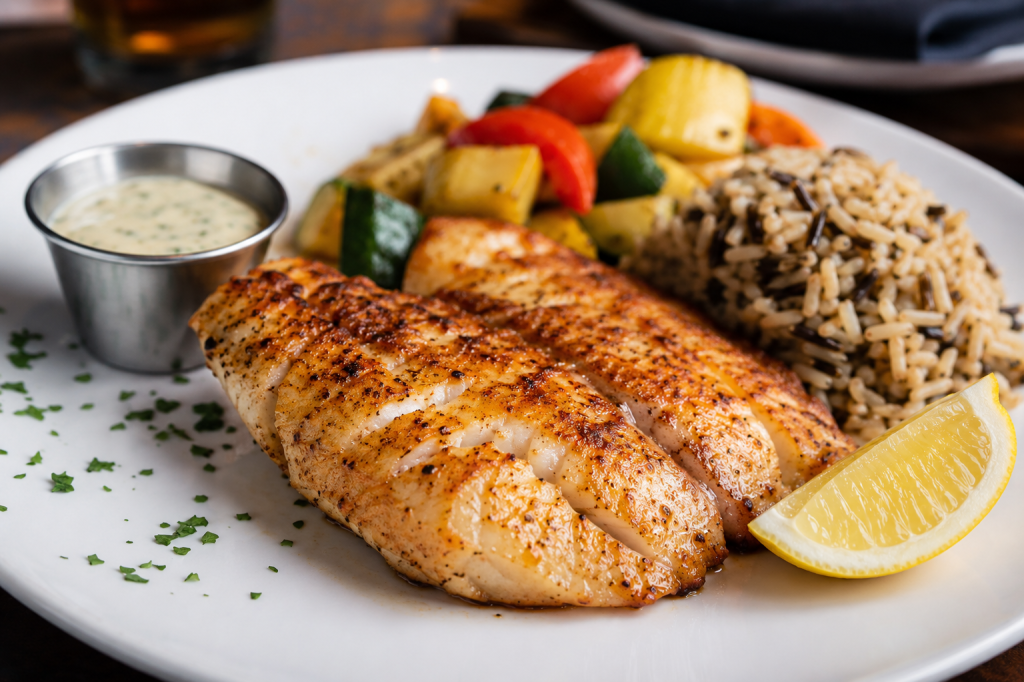
Spend enough time around restaurants in Florida and eventually somebody is going to ask about grouper.
Grouper sandwich. Blackened grouper. Fried grouper. Grouper tacos. Grouper Oscar.
It shows up everywhere from beach bars and seafood shacks to white-tablecloth restaurants, and for good reason. Grouper has a mild flavor, firm texture, and enough versatility to work across a wide range of menus.
But grouper is also a little more complicated than simply ordering a case of fish.
There are different species, different sizes, different origins, fresh and frozen options, skin-on and skinless fillets, portions, loins, and varying price points. And in a state like Florida, where customers actually recognize the name “grouper,” expectations can be pretty high.
So what exactly is grouper, and how did it become such an important part of coastal American cuisine?
What Is Grouper?
Grouper isn’t actually one single fish.
The name refers to a large group of fish primarily belonging to the sea bass family, with numerous species found throughout tropical and subtropical waters around the world.
In the United States, grouper is especially associated with the Gulf of Mexico, Florida, and the southeastern Atlantic coast.
Some of the species commonly encountered include:
- Red grouper
- Black grouper
- Gag grouper
- Yellowedge grouper
- Snowy grouper
There are also imported grouper species sold in the American market.
That distinction matters because two products labeled “grouper” may not necessarily be the exact same fish.
Species, origin, harvest method, size, processing and availability can all influence what ultimately ends up in the case—and what it costs.
Grouper and Florida
For Floridians, grouper isn’t just another seafood item.
It is part of the state’s food culture.
Florida’s location between the Gulf of Mexico and Atlantic Ocean helped seafood become a natural part of the state’s cuisine long before tourism turned coastal Florida into the destination it is today.
Commercial fishermen supplied local communities with snapper, mullet, shrimp, grouper and other species harvested from surrounding waters.
As Florida’s population and tourism industry grew throughout the 20th century, seafood restaurants followed.
And grouper was perfectly positioned for it.
It was local, relatively mild, easy to prepare and approachable for tourists who might not normally order a stronger-tasting fish.
Eventually, the grouper sandwich became practically synonymous with Florida’s Gulf Coast.
The formula is incredibly simple:
A piece of grouper.
A bun.
Lettuce and tomato.
Usually some tartar sauce.
Maybe a slice of cheese depending on where you go.
That’s about it.
But simplicity puts a lot of pressure on the fish itself. There isn’t much to hide behind when grouper is the centerpiece of the plate.
What Does Grouper Taste Like?
One of grouper’s biggest advantages is its flavor.
Grouper is generally mild and slightly sweet without having the stronger “fishy” flavor that turns some customers away from seafood.
The flesh is white, lean and firm with large flakes.
That combination makes it especially useful in restaurants because the fish can stand up to multiple cooking methods without immediately falling apart.
Compare that with a more delicate fish that requires careful handling on the grill or sauté station.
Grouper gives the kitchen some flexibility.
And flexibility is valuable.
The Culinary Applications
There probably isn’t one definitive way to cook grouper.
That’s part of what makes it such a good menu fish.
Blackened Grouper
This may be one of the most recognizable preparations.
The fish is coated with Cajun or Creole-style seasoning and cooked over high heat, traditionally in a cast-iron pan.
The mildness of grouper works particularly well here because the fish can handle aggressive seasoning without competing with it.
Serve it as an entrée with rice and vegetables, put it over a salad, or throw it on a sandwich.
Same fish. Completely different menu applications.
Grilled Grouper
A firm fish is your friend on a grill.
Grouper can be seasoned simply with salt, pepper, citrus, herbs or a seafood seasoning and cooked directly over the heat.
The result works especially well for coastal restaurants trying to keep the plate relatively light and simple.
Add vegetables, rice, potatoes or a fresh salsa and you have an entrée without needing a complicated preparation.
Fried Grouper
Then, of course, there is fried grouper.
Bread it.
Batter it.
Drop it in the fryer.
Put it on a plate, in a basket, inside tacos or on a toasted bun.
There is a reason fried grouper sandwiches are everywhere along Florida’s coast.
They are good.
From an operational standpoint, frying also gives restaurants an approachable preparation for customers who may be hesitant to order seafood.
Grouper Sandwiches
The grouper sandwich deserves its own category because restaurants have built entire reputations around them.
Blackened, grilled or fried grouper can all work.
The beauty of the sandwich is that the fish remains the star while the restaurant can still make the item its own.
Brioche bun.
Kaiser roll.
Tartar sauce.
Remoulade.
Cajun mayo.
Slaw.
Pickles.
Cheese.
There are countless variations, but the core idea remains the same.
A good piece of grouper on bread doesn’t need much help.
Grouper Tacos
Grouper also works extremely well in tacos.
Blackened grouper with cabbage, lime and crema gives you a completely different menu item from the traditional sandwich without dramatically changing the core ingredient.
That’s something restaurant operators should always appreciate.
One ingredient that can work in multiple places on the menu creates opportunities.
Sautéed or Pan-Seared Grouper
Move into a more upscale setting and grouper transitions easily.
A thick grouper fillet can be pan-seared and finished with butter, lemon, herbs, wine or a cream sauce.
You can pair it with risotto.
Put it over mashed potatoes.
Serve it with seasonal vegetables.
Finish it with beurre blanc.
Top it with crab meat.
Now the same fish you saw in a basket with French fries at a beach bar has become a $30-plus dinner entrée.
That’s versatility.
Grouper Oscar
One preparation worth mentioning separately is Grouper Oscar.
The “Oscar” treatment generally combines the fish with crab meat, asparagus and a rich sauce such as béarnaise or hollandaise.
It’s a great example of how grouper can move into higher-end dining.
The mild flavor provides a base for richer ingredients without disappearing underneath them.
It also gives restaurants an opportunity to combine two seafood items into a premium entrée.
Whole Fish Applications
Not all grouper has to arrive as a perfectly trimmed portion.
Whole grouper can be roasted, grilled or fried, particularly in Caribbean, Latin American and Asian cuisines.
Serving whole fish changes the experience entirely.
The bones and skin help protect the meat during cooking, while the presentation can be dramatic enough to become part of the dining experience itself.
Whole-fish utilization also opens the door to applications beyond the fillet.
Bones and heads can contribute to stocks and soups, while collars and other cuts can become menu items of their own in kitchens willing to use them.
Why Chefs Like Grouper
From a culinary standpoint, grouper checks a lot of boxes.
It has a recognizable name.
Customers perceive it as premium.
It has a mild flavor.
It works with numerous cooking methods.
It can handle strong seasoning.
And it can move between casual and upscale menus.
That’s a pretty useful combination.
Think about how many different restaurants can use essentially the same fish.
A waterfront bar can sell a fried grouper sandwich.
A Mexican restaurant can use it for fish tacos.
A Caribbean restaurant can serve it whole.
An upscale seafood restaurant can pan-sear it and finish it with crab and beurre blanc.
A hotel can serve a grilled grouper entrée.
Very few proteins are locked into only one identity, but grouper seems especially comfortable moving between concepts.
The Importance of the Spec
This is where the foodservice side becomes interesting.
“Grouper” isn’t always enough information when buying grouper.
A chef or operator may need to consider:
Species: What type of grouper is it?
Origin: Domestic or imported?
Fresh or frozen: What makes sense for the operation?
Fillet size: Does the restaurant want smaller fillets or larger fish that can be portioned in-house?
Portion size: Is the goal a 6-ounce sandwich portion or a larger dinner entrée?
Skin: Skin-on or skinless?
Bones: Is the product completely boneless, or does the kitchen need additional preparation?
Consistency: Can the restaurant get the same product week after week?
Those details matter.
A restaurant selling a grouper sandwich for $20-plus needs to know what is going between the buns.
Fresh vs. Frozen
There’s often a perception that fresh automatically means better.
It isn’t always that simple.
High-quality frozen seafood can be an excellent option, particularly when the fish is processed and frozen quickly after harvest.
Frozen grouper can also give restaurants more control over inventory and reduce the pressure of moving fresh product before quality declines.
Fresh grouper has obvious appeal, especially for seafood restaurants that can move enough volume to justify frequent deliveries.
But the right answer depends on the operation.
How much grouper are you selling?
How often are you getting deliveries?
How consistent is demand?
What is the price difference?
How much product are you throwing away?
Those questions matter just as much as whether the label says fresh or frozen.
The Cost of Putting Grouper on the Menu
Grouper’s popularity comes with a challenge.
It isn’t usually the cheapest fish in the building.
Wild-caught seafood markets can move based on seasonality, fishing conditions, regulations, weather, supply and demand.
That means a restaurant may love having grouper on the menu but still needs to pay attention to portion cost.
A one-dollar-per-pound movement doesn’t sound dramatic until you’re selling hundreds of pounds of fish.
Then start multiplying.
That is why portion control becomes important.
If the menu is priced around an 8-ounce portion but the kitchen regularly cuts 10 ounces, that difference adds up quickly.
The customer may never notice those extra two ounces.
The P&L eventually will.
Sustainability and Management
Grouper is also an example of why seafood sourcing can become complicated.
Many grouper species are relatively slow-growing and some take years to reach reproductive maturity. That makes responsible fishery management especially important.
Commercial and recreational fisheries can be subject to seasons, quotas, size limits, area closures and other management measures designed to protect stocks.
Those rules can also influence foodservice availability.
When you’re dealing with wild seafood, the supply chain ultimately starts with an animal living in the ocean.
You can’t manufacture another million pounds of wild grouper because restaurants suddenly want it.
That reality separates seafood from many other foodservice commodities.
More Than Just a Florida Fish
Grouper will probably always have a special connection to Florida.
And that’s part of its appeal.
There are certain foods that become associated with a place.
Lobster rolls in New England.
Crab cakes in Maryland.
Crawfish in Louisiana.
And along Florida’s Gulf Coast, the grouper sandwich has earned its place on that list.
But from a foodservice perspective, the story is bigger than the sandwich.
Grouper is a good example of what makes an ingredient valuable to restaurants in the first place.
It has customer recognition.
It has culinary versatility.
It works across multiple price points and restaurant concepts.
And underneath that simple piece of fish on the plate is an entire chain involving fishermen, processors, regulations, distributors, chefs and restaurant operators.
Which is usually the part of the plate I find the most interesting.


Leave a Reply