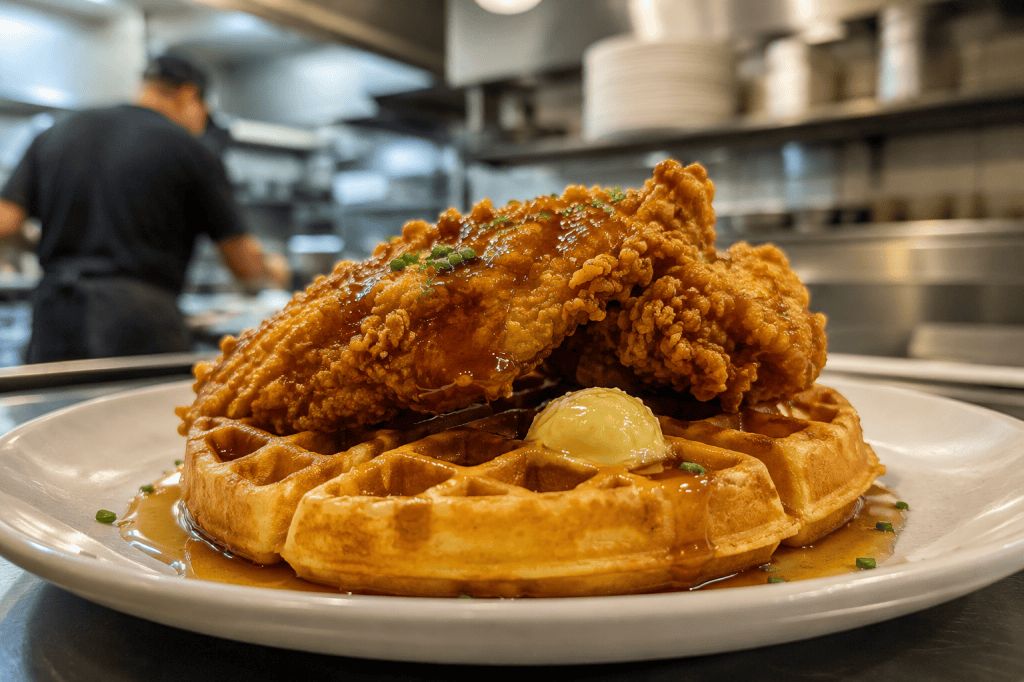
August 24 is National Waffle Day.
And while most people probably aren’t waking up this morning thinking about the economics of waffles, we here like to look at food a little differently.
Spend enough time working in restaurants and food distribution and eventually you stop seeing just the food on the plate, food just becomes part of your everyday.
You start seeing the ingredients, labor, equipment, food cost, menu price and specs, versatility, and everything else happening behind it.
And based off that, it actually makes waffles pretty interesting in the foodservice world.
A Little Waffle History
Waffles have been around in some form for centuries, but August 24 has a particular significance in American food history.
On August 24, 1869, Cornelius Swartwout of Troy, New York received a U.S. patent for an improved waffle iron.
The concept itself was much older. Early versions of waffle irons consisted of two metal plates that were heated over a fire. Eventually electric waffle irons made the process easier and helped turn waffles into the breakfast staple we know today.
The Belgian waffle would later become particularly popular in America following its appearance at the 1964 New York World’s Fair.
Today, waffles are everywhere—from hotel breakfast bars and diners to brunch restaurants, frozen food aisles and high-end restaurants putting their own spin on chicken and waffles.
But from an operator’s perspective, there is another reason waffles have survived for so long.
They’re VERSATILE.
A Simple Product With a Lot of Possibilities
At its core, a waffle isn’t particularly complicated.
Flour. Eggs. Milk. Fat. Leavening – a little sugar depending on the recipe.
Put those ingredients together, pour the batter into a hot waffle iron and you have a product that can become the foundation for dozens of different menu items.
That’s where things get interesting from a restaurant perspective.
The same basic waffle can be served with:
- Butter and maple syrup
- Strawberries and whipped cream
- Bananas and chocolate
- Fried chicken
- Bacon and eggs
- Ice cream
- Fruit compote
- Nut butters
- Hot honey
- Powdered sugar
Or, like the restaurant I used to work for, forget the plate completely and turn the waffle into a sandwich.
One base product suddenly has applications across breakfast, brunch, lunch, dinner and dessert.
That’s valuable menu real estate.
Cross-Utilization Is Where the Money Is
One of the biggest lessons I learned managing restaurants was that having more menu items doesn’t necessarily mean you need more ingredients.
Good menus find ways to use the same ingredients multiple times.
If a restaurant already carries chicken breast, strawberries, bacon, eggs, whipped cream, chocolate sauce and ice cream, a waffle program doesn’t necessarily require an entirely new inventory system.
You’re taking products already sitting in the walk-in, freezer and dry storage and finding another way to sell them.
That matters.
Every additional ingredient you bring into a restaurant creates another item that has to be ordered, received, stored, rotated, counted and eventually used before it goes bad.
Cross-utilization helps simplify that equation.
A waffle topped with strawberries and whipped cream might share ingredients with desserts.
Chicken and waffles can utilize the same fried chicken being used somewhere else on the menu.
Bacon and eggs obviously cross over throughout a breakfast menu.
That’s how a relatively simple item can become much more valuable to an operation.
The Chicken-and-Waffles Effect
Chicken and waffles might be one of the best examples of how far the waffle has moved beyond breakfast.
Sweet, salty, crispy, soft and savory all hit the plate at once.
And restaurants continue finding ways to reinvent it.
Chicken and waffles can become a traditional plated entrée, sliders, sandwiches, tenders with waffle bites or even a brunch special.
That versatility hasn’t gone unnoticed by major restaurant companies either.
In fact, Chick-fil-A launched limited-time Chicken & Waffles Sandwiches on August 24, 2026—the same day as National Waffle Day—with versions designed for both breakfast and later in the day.
Think about what that says about the category.
The waffle isn’t necessarily confined to breakfast anymore.
Breakfast Has Another Advantage: Perceived Value
Breakfast food has always fascinated me from a restaurant-business standpoint.
Many of the basic ingredients aren’t particularly exotic.
Eggs. Potatoes. Flour. Bread. Pancake mix. Waffle mix.
But combine those ingredients correctly, execute them consistently, add some protein and create a good presentation, and suddenly you have a meal guests are willing to pay considerably more for than the raw ingredients themselves.
Of course, that doesn’t mean breakfast restaurants are printing money.
Labor, rent, utilities, waste, credit card fees, insurance and everything else still have to be paid.
And anyone who has worked a busy Sunday brunch knows breakfast certainly isn’t easy.
But waffles provide operators with something every restaurant wants:
The ability to create something guests perceive as special without requiring an overly complicated ingredient list.
Waffles Are Built for Customization
Restaurants today also compete on presentation.
People eat with their eyes—and their phones.
A plain waffle with syrup is perfectly fine.
But add fried chicken, hot honey and powdered sugar?
Now you have something completely different.
Add strawberries, whipped cream and chocolate drizzle?
Different customer. Same waffle.
Add ice cream, caramel and crushed cookies?
Now breakfast just became dessert.
This gives restaurants the ability to create premium versions of a relatively simple product while keeping the underlying operation manageable.
It also makes waffles perfect for limited-time offers.
Pumpkin waffles in the fall.
Peach cobbler waffles during the summer.
Red velvet waffles around Valentine’s Day.
Chicken and waffles for brunch.
The equipment doesn’t change.
The base product barely changes.
The story around it does.
The Distributor Behind the Waffle
And like almost everything on a restaurant menu, there’s an entire supply chain behind that waffle.
The flour may come from one manufacturer.
Eggs from another.
Butter from another.
Syrup from another.
Fresh strawberries may travel through a completely different supply chain.
The chicken could come from a poultry processor hundreds of miles away.
Then you’ve got whipped topping, cooking spray, powdered sugar, takeout containers, napkins and cleaning chemicals.
A customer sees breakfast.
A restaurant operator sees a menu item.
A distributor rep sees dozens of products moving through warehouses and trucks before that waffle ever reaches the table.
That’s the part of foodservice most people never see.
More Than Just Breakfast
National Waffle Day might be another one of those quirky food holidays that shows up on social media.
But the waffle itself is a pretty good example of what makes certain menu items survive generation after generation.
It’s familiar.
It’s customizable.
It’s relatively simple.
It works sweet or savory.
It can move across multiple dayparts.
And restaurants can continuously reinvent it without reinventing their entire kitchen.
Sometimes the best menu items aren’t the most complicated ones.
They’re the ones that give operators the most ways to make something people want to order.
And 157 years after Cornelius Swartwout received his waffle iron patent, restaurants are still finding new ways to sell them.
That’s a pretty good run for some batter cooked between two hot pieces of metal.


Leave a Reply