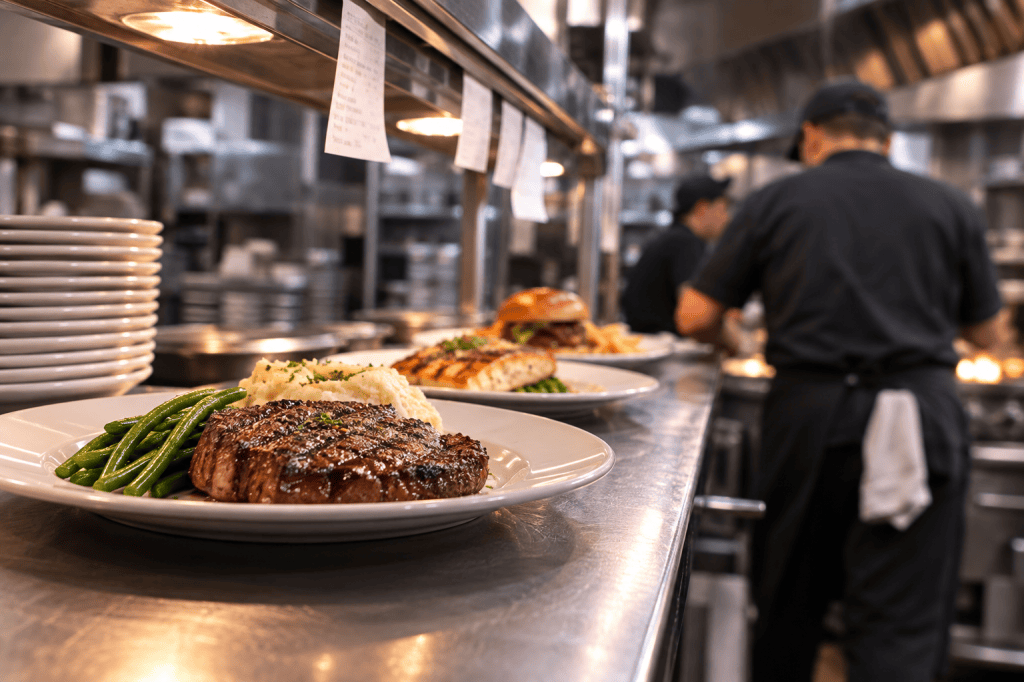
Walk into a busy restaurant on a Friday night and everything can look pretty simple or pretty messy from the outside.
The dining room is full. Drinks are flowing. Servers are running around. Food is flying out of the kitchen. There might even be a line at the door.
You look around and think, Man, this place has to be making a killing.
Maybe…
But probably not as much as you think.
Restaurants are one of those businesses where a lot of money can move through the building without a lot of it actually staying there, similar to farming
A restaurant can do millions of dollars in annual sales and still operate on surprisingly thin margins. Behind every burger, steak, cocktail, and plate of pasta is an economic balancing act involving food costs, labor, rent, utilities, insurance, credit card fees, waste, repairs, and about a hundred other expenses customers never see.
Having spent years in restaurant management and now working on the food distribution side of the industry, I’ve had the opportunity to see both sides of that equation.
And the economics behind your dinner are a lot more complicated than they appear.
A $20 Meal Isn’t $20 of Profit
This is probably the biggest misconception about restaurants.
If a restaurant sells you a meal for $20, the owner isn’t putting $20 in their pocket.
Before that plate ever reaches your table, the restaurant has already paid for the ingredients.
Then somebody had to prep it.
Somebody had to cook it.
Somebody had to serve it.
Somebody had to wash the plate afterward.
The building has rent. The lights have to stay on. The walk-in cooler has to stay cold 24 hours a day. There are insurance premiums, cleaning chemicals, pest control, linen services, trash removal, equipment repairs, software subscriptions, credit card processing fees, licenses, and dozens of other expenses.
And hopefully, after paying for all of that, there’s something left over.
That, in a nutshell, is the restaurant business.
Food Cost: Every Ounce Matters
Food is obviously one of the largest expenses in a restaurant, but managing food cost goes much deeper than finding the cheapest case of chicken.
Let’s say beef prices increase.
The restaurant has several choices.
Raise the menu price.
Reduce the portion.
Find another product.
Accept a smaller margin.
Or remove the item altogether.
None of those decisions happen in a vacuum.
Raise prices too aggressively and customers notice. Reduce portions too much and customers notice that too. Switch to an inferior product and you risk sacrificing the quality that brought people through the door in the first place.
That’s why purchasing matters so much.
A few cents per pound might not sound like much. Multiply it by hundreds or thousands of pounds over the course of a year and suddenly you’re talking about real money.
The same goes for portion control.
If a recipe calls for six ounces of chicken and the kitchen consistently serves seven, that extra ounce isn’t free.
Do it hundreds of times every week and your food cost starts walking out the kitchen door one ounce at a time.
Then There’s Labor
Food isn’t the only major cost.
People are expensive—and restaurants require a lot of them!!
Cooks.
Dishwashers.
Servers.
Bartenders.
Hosts.
Bussers.
Managers.
Prep cooks.
Depending on the operation, you may also have bakers, catering employees, food runners, receivers, and other specialized positions.
The challenge is that restaurants have to schedule labor before knowing exactly how much business they’re going to do.
Schedule 15 people for Friday night expecting to get slammed and business doesn’t show up?
You still have to pay them.
Schedule eight people because you’re trying to control labor and suddenly 200 customers walk through the door?
Now you’ve created an entirely different problem.
Ticket times increase. Employees get overwhelmed. Service suffers. Customers complain.
Restaurant managers are constantly trying to predict demand before it happens.
Sometimes you’re right.
Sometimes you’re staring at an empty dining room wondering where everybody went.
Waste Is More Expensive Than It Looks
One of the fastest ways to destroy restaurant profitability is waste.
A case of produce spoils.
A steak gets overcooked.
Someone drops a pan of food.
An employee over-portions.
The wrong product gets ordered.
Twenty people make reservations and don’t show up.
Every one of those situations costs money.
And unlike many other businesses, restaurants deal heavily in perishable inventory.
A hardware store can leave a hammer sitting on the shelf for six months.
A restaurant can’t do that with a case of strawberries.
The clock starts ticking almost immediately.
That’s why inventory management, forecasting, storage, rotation, and ordering are such important parts of restaurant operations.
The Menu Is an Economic Tool
A good menu isn’t simply a list of food people want to eat.
It’s a financial tool.
Some items generate significantly more profit than others.
A restaurant might make more money selling a $16 burger than a $32 steak because the cost structure behind those two dishes is completely different.
That’s why smart operators pay attention to more than food cost percentage.
They look at the contribution margin—how many actual dollars an item contributes toward paying the restaurant’s other expenses. At the end of the day, you can’t deposit percentages into the bank
They also pay attention to popularity.
A highly profitable menu item doesn’t do much good if nobody orders it.
On the other hand, a wildly popular item with terrible margins can keep the kitchen busy without doing much for the bottom line.
The sweet spot is finding dishes customers love that also make financial sense for the restaurant.
The Cost of Convenience
This is another part of restaurant economics I’ve come to appreciate even more working in food distribution.
Sometimes the cheapest product isn’t actually the cheapest product.
Take produce.
A restaurant could purchase whole vegetables and have employees wash, peel, trim, and cut everything themselves.
The case price might be cheaper.
But what does the labor cost?
How much product gets trimmed away?
How consistent are the portions?
How much additional prep space is required?
How much waste is generated?
Sometimes paying more for a pre-cut or value-added product actually lowers the restaurant’s total operating cost.
The same principle applies throughout foodservice.
Operators aren’t simply buying food.
They’re buying labor savings, consistency, shelf life, convenience, availability, and predictability.
That’s part of the value distributors and manufacturers provide that isn’t always visible when someone simply compares two case prices.
Volume Doesn’t Always Equal Profit
This is another lesson that can surprise people.
Being busy doesn’t necessarily mean being profitable.
A restaurant could increase sales by running aggressive discounts, oversized portions, or promotions that generate a ton of traffic.
The dining room looks packed.
The kitchen is slammed.
Sales numbers look fantastic.
But if the restaurant spends $1.05 generating every $1.00 in sales, congratulations—you’ve built a very busy way to lose money.
That’s why operators have to look beyond revenue.
Sales matter.
But margins matter too.
Small Changes Become Big Numbers
This might be my favorite part of restaurant economics.
Tiny improvements compound.
Save three cents per pound on a high-volume protein.
Reduce waste by 1%.
Improve portion control.
Schedule labor slightly better.
Increase the selling price of a popular item by fifty cents.
Reduce credit card fees.
Improve inventory turns.
Negotiate a better contract.
None of those changes individually sound revolutionary.
But restaurants process thousands upon thousands of transactions.
Small improvements multiplied across an entire year can become tens of thousands of dollars.
The opposite is also true.
Small inefficiencies can quietly bleed a restaurant dry.
Why Restaurants Are So Difficult
Restaurants combine manufacturing, retail, hospitality, logistics, and customer service under one roof.
You’re purchasing raw materials.
Managing inventory.
Producing a finished product.
Managing employees.
Predicting demand.
Marketing the business.
Maintaining equipment.
Managing suppliers.
And serving customers in real time.
Oh, and your finished product is perishable.
And your customers can review the entire experience online before they’ve even left the parking lot.
It’s a tough business.
Having managed restaurants myself, I can tell you that when you’re sitting at a table enjoying dinner, there is an entire operation happening behind the walls that most customers will never see.
Now that I work in food distribution, I see another layer behind that.
Behind the restaurant are farmers, manufacturers, processors, buyers, warehouses, truck drivers, salespeople, logistics teams, and distributors all working to get the products into that kitchen in the first place.
The Business Behind the Plate
That’s really what fascinates me about the foodservice industry.
The customer sees the plate.
I see everything that had to happen for that plate to exist.
Someone grew it.
Someone processed it.
Someone sold it.
Someone transported it.
Someone received it.
Someone stored it.
Someone prepped it.
Someone cooked it.
Someone served it.
And somewhere along that entire chain, everybody has to make enough money to stay in business.
That’s the hidden economics of restaurants.
The next time you’re sitting in a packed restaurant and thinking, These guys must be making a fortune, remember:
A full dining room is only the beginning.
The real question is what happens to every dollar after it comes through the door.


Leave a Reply