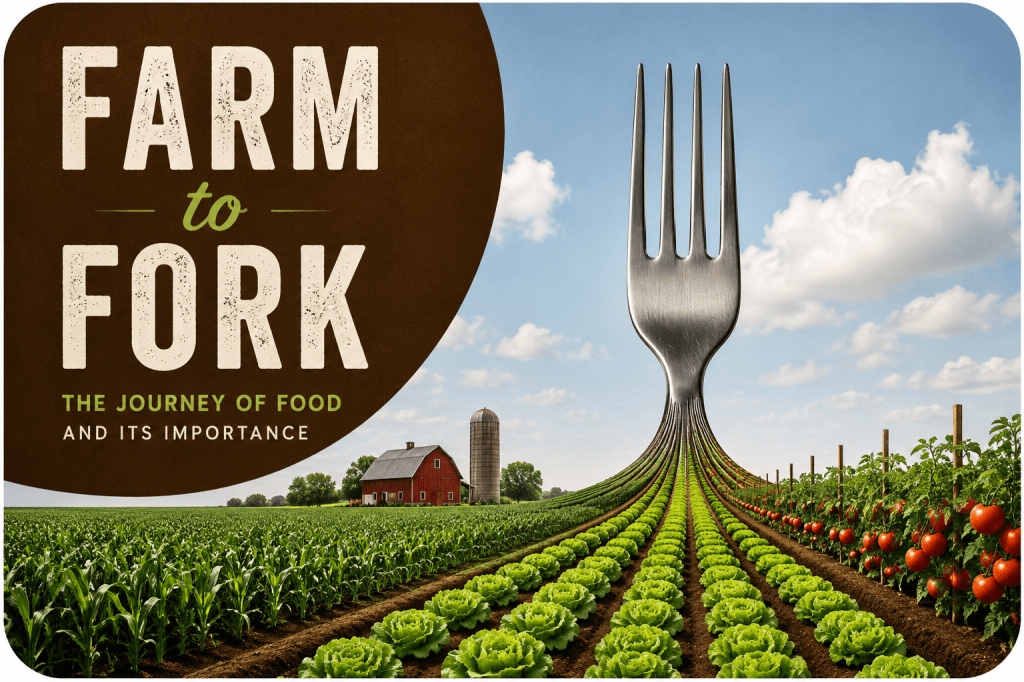
Most people have a general idea of where food comes from.
It starts on a farm—either in the ground or from an animal.
Eventually, it ends up on a plate in a restaurant, school, hospital, grocery store, or around the dinner table at home.
What many people don’t realize is how much has to happen in between.
Food doesn’t simply leave a farm and magically appear in a restaurant kitchen—this isn’t Penn & Teller. There’s an entire network of farmers, processors, manufacturers, distributors, warehouse employees, truck drivers, buyers, and logistics professionals working behind the scenes to make that happen.
The process is far more complex than most people realize.
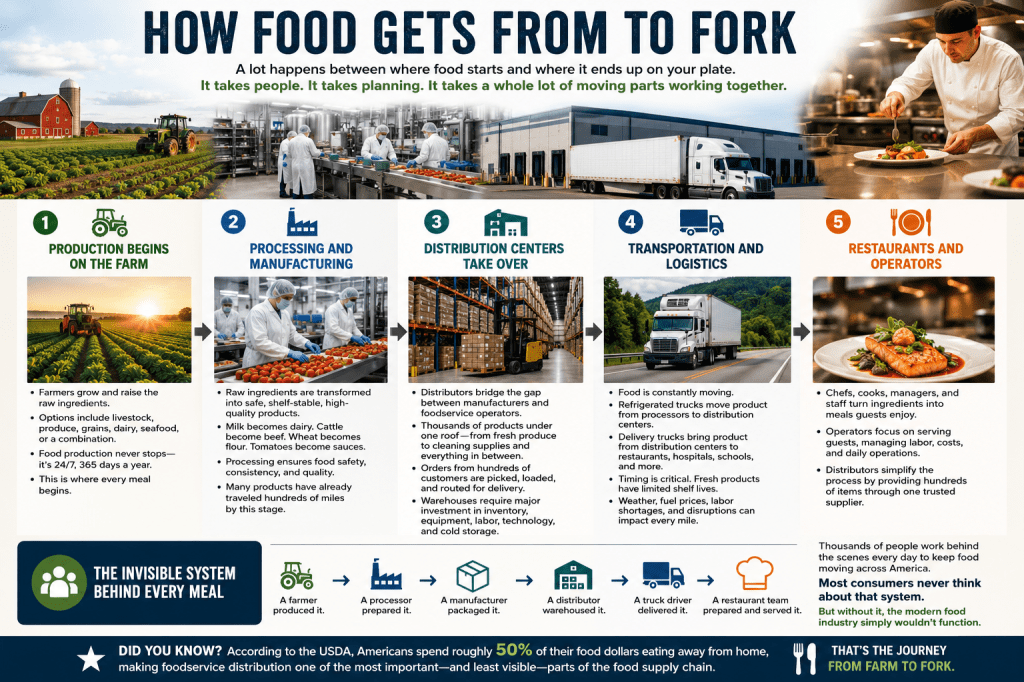
Step 1: Production Begins on the Farm
Everything starts with the people who grow and raise our food: farmers.
Depending on the product and how a farm operates, that might mean raising cattle, growing vegetables, harvesting grains, producing milk, or catching seafood. Many farms produce a combination of these.
Growing up on a dairy farm in Southwest Virginia, I learned early that food production never stops. Cows still need to be fed and milked whether it’s a holiday, raining, or the middle of winter.
What I didn’t appreciate at the time was how many industries depended on that milk eventually reaching consumers—or how much work and expense it took to get it there.
Step 2: Processing and Manufacturing
Most food doesn’t leave the farm ready for consumers.
Milk must be pasteurized and processed into dairy products.
Cattle are processed into beef products.
Wheat becomes flour.
Tomatoes become sauces.
Raw ingredients are transformed into products that restaurants and consumers can actually use.
Modern food processing also plays a major role in food safety, quality control, shelf life, and consistency.
By the time many products leave a processing facility, they may have already traveled hundreds of miles from where they were originally produced.
Step 3: Distribution Centers Take Over
This is where one of the least understood parts of the food industry enters the picture.
Food distributors act as the bridge between manufacturers and foodservice operators.
Instead of a restaurant buying directly from dozens—or even hundreds—of suppliers, distributors consolidate those products into one delivery network.
A typical distribution center may contain thousands of products ranging from fresh produce and frozen seafood to paper goods, cleaning chemicals, and beverages.
Orders from hundreds of customers are picked, loaded onto trucks, and delivered according to carefully planned routes.
The scale is impressive—but so are the costs. Warehouses require millions of dollars in inventory, refrigeration systems, equipment, labor, technology, and transportation to keep food moving efficiently.
A single distribution center can move millions of pounds of product every week while maintaining strict food safety standards and temperature controls.
Step 4: Transportation and Logistics
Food is constantly moving.
Refrigerated trucks transport products from processors to distribution centers.
Delivery trucks transport products from distribution centers to restaurants, hospitals, schools, hotels, and other operators.
Every mile requires fuel, equipment, maintenance, and drivers.
Timing matters.
Fresh products have limited shelf lives. Restaurants depend on deliveries arriving when expected. Weather events, fuel prices, labor shortages, and supply chain disruptions can all impact the movement of food.
When people hear the term “supply chain,” this is often the part they picture.
The reality is that transportation is only one piece of a much larger system.
Step 5: Restaurants and Operators
Once products arrive, restaurant operators take over.
Chefs, cooks, managers, and staff transform those ingredients into the meals customers enjoy every day.
As someone who spent years in restaurant management, I can tell you that most operators don’t have the time to manage dozens of supplier relationships.
They’re focused on serving guests, managing labor, controlling food costs, handling maintenance issues, and keeping their businesses running.
Food distributors simplify that process by allowing operators to purchase hundreds of products through a single supplier relationship.
The Invisible System Behind Every Meal
The next time you sit down for dinner, think about everything that had to happen before that food reached your table.
A farmer had to produce it.
A processor had to prepare it.
A manufacturer had to package it.
A distributor had to warehouse it.
A truck driver had to deliver it.
A restaurant team had to prepare and serve it.
Thousands of people work behind the scenes every day to keep food moving across America.
Most consumers never think about that system.
But without it, the modern food industry simply wouldn’t function.
And that’s what makes the business behind the plate so fascinating.


Leave a Reply